Note: This post was automatically imported from Substack. The import process is not perfect, so please excuse any missing / broken links or images.
… but that doesn’t mean we can’t resist
On the podcast last week, I spoke about my problem with Charlie Kirk. The biggest issue was, to my mind, that he made politics into a spiritual battle of good vs evil, where the Republicans were good / on God’s side, and the Democrats were evil / on Satan’s side. I believe it is wrong to do this under ANY circumstances (no one individual or political party is entirely good or evil). However, I believe that Kirk’s uncritical endorsement of Trump as the godly candidate is especially inexcusable. As I said in the podcast, Trump is far from a good and godly man of righteousness who is simply trying to do the right thing. I believe he is helping to bring about a deeply troubling, evil agenda — do go back and catch up with the podcast and check out the links for more. The problem is, at its most fundamental, you cannot speak about the evil on only one side of the political aisle. If you’re a Christian, you must speak about it all.
So, now Charlie Kirk is dead (or maybe I should say, written out of the script) — do these questions still matter? I believe it’s even more important for us to think through these issues. This is especially true of those of us in the UK: forces are at currently at work to encourage Christian Brits to join political movements. For example, the other day YouTube presented me with this video: “Why Christians are backing Restore Britain,” featuring a woman explaining why as a Christian woman she supported Rupert Lowe’s movement Restore Britain. I’ve also seen another video promoted on YouTube, Why Tommy Robinson and his followers are turning to Christianity — a report by Sky News.
Christianity is being used as a way of encouraging people to vote a particular way or support a political movement. Although we don’t have the same Christian Right as exists in the US, there is a growing movement of people who are interested in Christianity. It’s important for the enemy’s purpose that all those with a renewed interest in Christianity (thanks to the so-called ‘Quiet Revival’) be gathered up into political movements. “Do you want Britain to be a Christian country? Then come and join our political movement…”
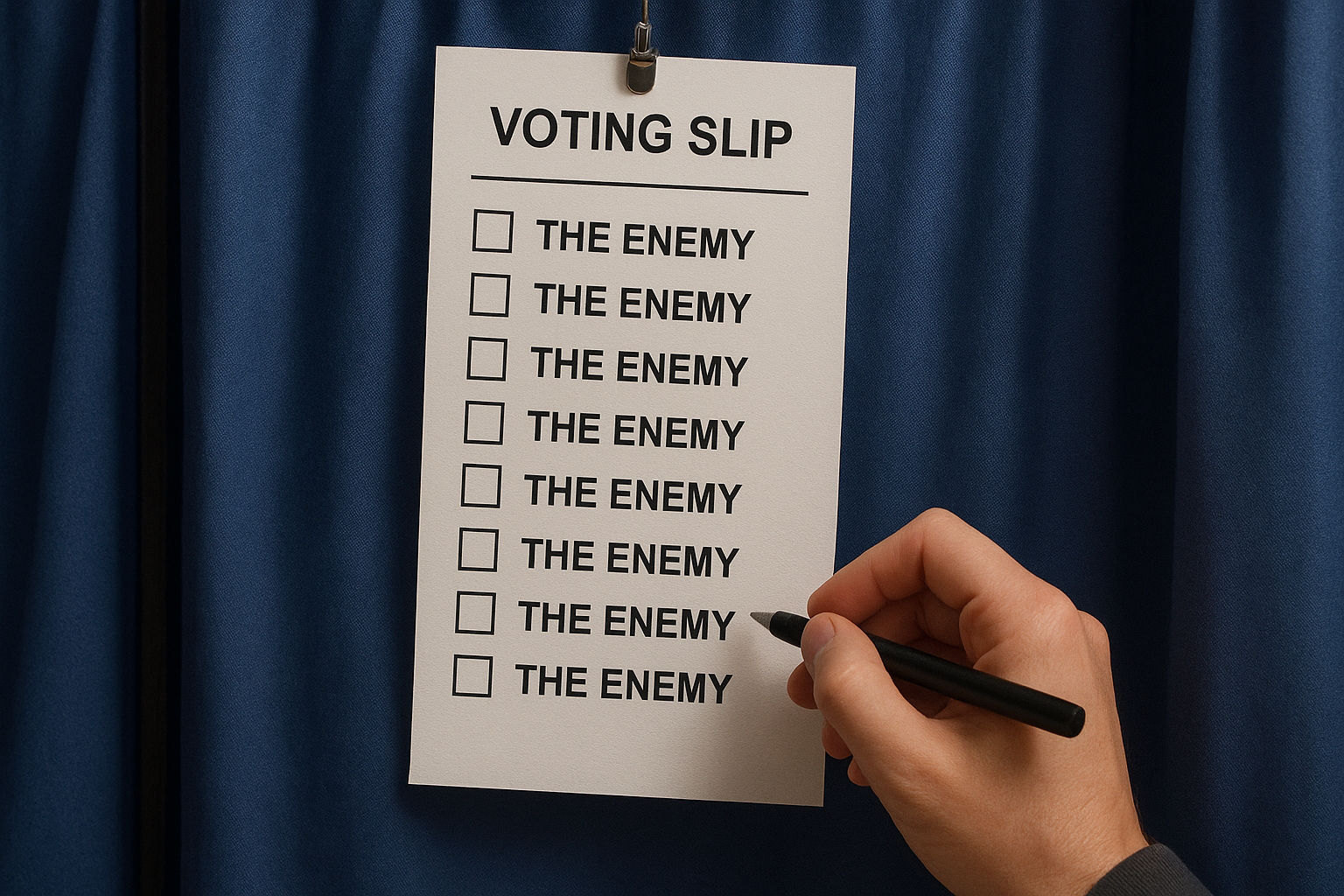
So, what’s the problem with this? Let me start by explaining why I believe that voting is not going to solve our current problems.
Why voting will not solve our problems
The core problem with voting is that it assumes the people in charge are the people we actually elect. I believed for a long time that a big part of our problem was that we were voting for the wrong people. Therefore, all we needed to do was vote for the right people, and — hey presto! — everything would be sorted out.
How utterly naïve I was! What we’ve seen time and again over the last few years is that the people who are actually in control are not our elected politicians. That doesn’t mean that our elected officials don’t have any power or influence, but rather the people calling the shots about some of the biggest issues are in the shadows. One of my biggest realisations over the last few years is how deep it goes — shadowy figures are making big decisions which affect all our lives without us even knowing who they are.
Note: if you’d like to find out more about what’s going on, a good introduction is Derrick Broze’s documentary series The Pyramid of Power.
It seems to me — and please correct me if I am wrong — that none of the political hopefuls competing for our allegiance really acknowledges this. Can we trust them, therefore, to fight against it if they don’t even acknowledge its existence?
Jesus once spoke these words:
“Suppose one of you wants to build a tower. Won’t you first sit down and estimate the cost to see if you have enough money to complete it? For if you lay the foundation and are not able to finish it, everyone who sees it will ridicule you, saying, ‘This person began to build and wasn’t able to finish.’
“Or suppose a king is about to go to war against another king. Won’t he first sit down and consider whether he is able with ten thousand men to oppose the one coming against him with twenty thousand? If he is not able, he will send a delegation while the other is still a long way off and will ask for terms of peace.”
Luke 14:28-32
The point here is that you can’t set out to do something without knowing what you are up against. If you don’t know the full scale of the enemy (so much as we can know at the moment, given the secrecy), then you’re not going to succeed. As much as I might respect men like Ben Habib and Rupert Lowe, if they are not prepared to acknowledge how deep the problem is, why should I trust that they would be able to deal with it effectively?
They may be able to come up with more sensible policies on finance or immigration and even be able to implement them. However, the heart of the problem will still remain: the “powers that shouldn’t be” won’t be touched and will simply find another way to further their agenda. In fact, it seems likely to me that we are currently being provoked into voting for Reform by these same powers. For them, voting is a convenient way of giving us the illusion of choice and accountability, while enabling them to continue their own schemes unhindered.
Part of the problem is that what we are up against is not simply incompetence or apathy, but something more fundamentally evil. I spoke last year about the demonic agenda at play, which might sound over-the-top and dramatic but is in fact basic Christian teaching: there is a spiritual war going on. There is something beyond mere human greed and corruption at play, but there is a spiritual root to the evil we see unfolding.
A spiritual problem needs a spiritual solution
A couple of years ago, Right Said Fred released their song It’s a Spiritual War. As I’ve said here ad nauseam (sorry, but not sorry — it’s important), many people have realised over the last couple of years that there is a battle between good and evil going on. The problem is, how do we respond to it? What should we actually do about it?
The song tells us:
So get your boots on, so get your boots on
So fill your hearts up with love and good will
I presume that ‘getting your boots on’ is a reference to the fact that we all need to do something. We are also told, ‘fill your hearts up with love and good will.’ I absolutely agree that we DO need to do something — all of us — and I absolutely agree that love is the essence of the solution. But their solution is lacking something essential.
Compare what they say these words from the Bible:
Finally, be strong in the Lord and in his mighty power. Put on the full armour of God, so that you can take your stand against the devil’s schemes. For our struggle is not against flesh and blood, but against the rulers, against the authorities, against the powers of this dark world and against the spiritual forces of evil in the heavenly realms. Therefore put on the full armour of God, so that when the day of evil comes, you may be able to stand your ground, and after you have done everything, to stand.
Ephesians 6:10-13
As you can see, it’s another passage about there being a spiritual war — but the key difference is right there in the opening line: “be strong in the Lord and in his mighty power.” The apostle Paul says we need to stand strong in God’s power, because we cannot stand in our own strength. In order to do that, we need to put on the full armour of God, which he goes on to explain.
Paul recognises the reality of our own human weakness. If we try to stand against evil in our own strength, if we try to overcome by human tactics and efforts, then we will fail. This is because we are against true spiritual evil. Spiritual evil cannot be stopped by human means.
Although the song by the Freds is a good start, inasmuch as we need to recognise there is a spiritual war going on, the answer is not ‘get your boots on’ but ‘repent of your sins and trust in Jesus’. Jesus alone can give us the strength and power that we need to overcome. For example, when they say “fill your hearts up with love” — who has the power to do that to themselves? Love isn’t something we can work ourselves up to. Instead, as I said previously, love is what is given to us when we draw closer to God. Love IS key to overcoming, but that love is a gift of God to us when we ask him for it.
Let me illustrate with an example from the Bible.
Case study: Saul
Over the last few weeks, I’ve been preaching through the Old Testament book of 1 Samuel. I’ve found it a fascinating book to explore, and I’ve seen many things there which I’d never seen before. In particular, one thing which has really struck me this time is the way that the people ask for a king because they are afraid of another nation called the Ammonites. They ask Samuel for a King because they want him to fight their battles (basically, to keep them safe).
What struck me is how this request comes from a very wrong motive: although having a king was neither right nor wrong in itself, it was wrong for the Israelites to reject God — the one who had always defended them against their enemies — and ask for a king instead. You could say, they were looking for a human solution to a spiritual problem.
The Israelites did not understand the real issue: they did not not trust in God for his protection and deliverance, they did not seek his will or his ways of righteousness. Instead, they were simply looking for security which would enable them to carry on living in peace without him.
It’s hit me many times how many parallels there are to today: I think a lot of people in Britain like the idea of having a ‘Christian’ country, but they don’t really want to do the hard work of living by faith, repenting of their sins, reading the Bible, praying, seeking God’s will for their lives, and so in. They simply want someone to come in and implement a few more sensible policies so that they can get back to living their lives without God. They are ultimately looking for the solution in a human being rather than God.
It didn’t end well for the Israelites, and it won’t end well for us if we go down this same path. If we look to human solutions to spiritual problems, without seeking God’s will, we will accomplish nothing.
Note: If you’d like to see the sermons on Saul, check out the whole playlist on YouTube, especially from chapter 8 onwards.
How we should face the battle
So, if we are engaged in a spiritual war, and we need to fight in a spiritual way, what should we actually do? Let’s finish by outlining three lessons for us.
1. Do not fear “the powers that shouldn’t be”
Most of us will not be in a position to do anything about the “powers that shouldn’t be”. At the end of the day, most of them are in the shadows somewhere, beyond the reach of the vast majority of the population. We can’t vote them out, because they are not democratically elected.
The important thing is that we mustn’t fear them, or allow them to cause us to live in fear. As I’ve said many times here, “do not fear” is the most oft-repeated command in the Bible. One of the things which I noticed during the scamdemic was how fear was everywhere: the authorities wielded fear like a weapon, as Laura Dodsworth pointed out in her book A State of Fear. But there was (and still is) a kind of parallel fear in the so-called ‘truth community’ — a fear of authoritarianism. But Christians of all people should never live in fear.
If I was to summarise everything about the way the Bible tells us we should live in one sentence, I would put it something like this: “Always do what is right and loving in God’s eyes and with his help; don’t let them stop you, and do not fear the consequences.” For example, during covid, when we were forbidden from meeting, the right thing to do would have been to ignore what they said and met up anyway. Meeting may have been against the rules or ‘guidance’, but it was certainly not an immoral thing to do in God’s eyes. In fact, it was the complete opposite: the immoral thing was to stay away from other people and to treat each other merely as vectors of disease. I wish I’d been a bit more confident in doing what I thought was right at the time, I was far too compliant with the rules.
You might ask, how can we do the right thing and not worry about the consequences? Doing the right thing does have consequences, such as losing friends, losing jobs, losing reputation, even (in extreme cases) losing our lives. Surely we should be worried about those things?
You could say a lot here, far too much than we have time for here, but the most important one is that we need to entrust ourselves to God. All through history, Christians have been persecuted despite wanting nothing but the best for others. Chiefly, of course, we see this in Jesus, who was put to death even though he never did a single thing wrong. We are not greater than our master. We need to commit to doing what our heavenly Father wants us to do, rather than worrying about what our earthly overlords want us to do (or not to do). As the apostles put it, “We must obey God rather than human beings!” (Acts 5:29).
Jesus said:
“I tell you, my friends, do not be afraid of those who kill the body and after that can do no more. But I will show you whom you should fear: Fear him who, after your body has been killed, has authority to throw you into hell. Yes, I tell you, fear him. Are not five sparrows sold for two pennies? Yet not one of them is forgotten by God. Indeed, the very hairs of your head are all numbered. Don’t be afraid; you are worth more than many sparrows.”
Luke 12:4-7
If we fear the Lord, we need not fear anything or anyone else. If we are seeking to please him, it doesn’t matter what anyone else thinks. That may bring us into conflict with the authorities sometimes, and many Christians through the years have experienced this. Some of them have even been killed for their faith. We should learn and take courage from their example. The apostle Paul said “if God is for us, who can be against us?” (Romans 8:31). This must be the attitude that we take into our lives and our decisions — let’s consider that in a separate point.
Note: if you’d like some encouragement on this front, you might like J.C. Ryle’s book Five English Reformers. The book gives a brief biography of five English men who were martyred at the time of the Reformation because of their stand for the truth of the Scriptures. I find it encouraging to know how God gave them the courage to stand, and how their faith and bravery won in the end.
2. Don’t participate in evil
Solzhenitsyn once wrote a very wise piece called Live Not by Lies. There, he wrote these words:
And therein we find, neglected by us, the simplest, the most accessible key to our liberation: a personal nonparticipation in lies! Even if all is covered by lies, even if all is under their rule, let us resist in the smallest way: Let their rule hold not through me!
I think this is a great (Christian) principle: where there is evil in the world, don’t play any part in it. We can’t help there being evil in the world, all we can do is refuse to take any share in it.
A lot of people are concerned about what’s going on in the world today, but they go along with it because they feel they don’t have a choice. For example, some of the medical staff who spoke out during covid have spoken of colleagues who messaged them privately and said “I agree with you, but I can’t support you publicly…” I’ve had conversations with people who privately disagreed with the lockdown measures etc., but didn’t say anything about it. I know there were people in my old church who disagreed with things like the climate change narrative, but they didn’t speak out about it publicly. It puts me in mind of that saying, “All it takes for evil to triumph is for good men to do nothing.”
If you disagree with something happening in an area you are involved with — for example, your workplace, or your child’s school, or a community organisation — don’t simply shrug your shoulders and keep quiet. Speak up. Make a fuss. Be awkward! Say ‘not in my name’.
I appreciate this is not an easy thing to do — especially for typical British people. We Brits tend to prefer ‘not to make a fuss’. But, sometimes making a fuss is exactly the right thing to do. Don’t think of yourself alone, but think how your bravery to speak up will help other people to be brave and speak up as well. Courage begets courage.
A lot of people fear the consequences of speaking up, which I’ve already mentioned. I would just add to what I said there that if we always keep quiet and just go with the flow, will things ever change? What kind of world do you want to leave as an inheritance for your children and grandchildren? Their future, and all our futures, depends on our courage in the here and now. If we turn a blind eye to evil now, what will they have to put up with in the future? This fight is not just for us — it’s for them.
Don’t fear what might happen if you lose your job or lose friends — I can testify to the fact that God can provide in both instances. Do the right thing and trust the consequences to God.
3. Love your neighbour
This is probably the most counter-intuitive thing about the godly way to respond to the evil in the world. What does loving your neighbour have to do with resisting the psychopaths currently in charge?
The answer is, what the psychopaths want more than anything is to keep us from one another. There’s nothing they hate more than a community of people who actually love and care for one another — a healthy community is the kryptonite to their Superman. Muse once wrote a song with the line in “love is our resistance”, which absolutely nails it.
This shouldn’t surprise us, given that love is basically the one-word summary of what God wants from us. As Paul puts it: “Let no debt remain outstanding, except the continuing debt to love one another, for whoever loves others has fulfilled the law” (Romans 13:8). If we are motivated by love, then we will always do what is right.
There is one important caveat here, though: love does not come naturally to us. Love is something that we need to ask God for. Love is a gift of the Holy Spirit (Galatians 5:22) — he is the one who gives us that which we cannot do ourselves. The upshot of this is, when I say “love your neighbour”, I’m not saying: ‘try really, really hard to be nice.’ I’m saying, you can’t do it in your own power — but pray to God daily, ask him for forgiveness for the times we fail, and ask for his help and power to do what we cannot do ourselves. It is through his strength that we are able to love in ways we could never have dreamt of before.
In my opinion, healthy, loving people and healthy, loving communities are the only things which are going to be strong enough to withstand the powers that shouldn’t be. That is our resistance, that is how we fight back.
Leave a Reply