
Note: This post was automatically imported from Substack. Please excuse any broken links or images!
Rethinking Church, part eight

With this piece we reach the final part of the ‘Rethinking Church’ series. The topic is such a controversial one — some might say it’s been the most divisive and controversial issue in the whole history of the church — that I’ve been putting it off. However, it’s time to stop prevaricating, take the bull by the horns, face the music, and confidently mix my metaphors. In this piece we are going to look at the Lord’s Supper, also called the Eucharist, Communion, or the Mass.1
I grew up in Baptist / independent evangelical churches, which tend to be more informal when it comes to communion. For example, I never went to a ‘Midnight Mass’ service on Christmas Eve throughout my entire childhood. In fact, I think the first time I went to a midnight communion was at my old church, once I was ordained. My abiding memory of those services was not simply the fact that it was very late and I was very tired, but that you would often see people coming out to them who you wouldn’t see the rest of the year. I began to realise that some people — not many, but a few — had the idea that coming to Midnight Mass was their annual offering to God. In their minds they a deal with God — they’d basically ignore him the rest of the year, but so long as they came to Midnight Mass it was fine.
It’s hard to know how common this view is, but it’s undeniable that large parts of the church see the Lord’s Supper as just about the most important human activity we can engage in. For example, Calvin Robinson — coming from the Anglo-Catholic perspective — once said: “Everything revolves around the Mass, the source and summit of the Christian faith.” Priests in Catholic and Anglo-Catholic churches will usually celebrate Mass on a daily basis, and there are a number of days of obligation when Catholics are required to attend Mass (and not to attend is a sin, unless there is a very good reason).2 Even churches which don’t see the Supper in this way do still view it as some kind of high point in the life of the church — it’s hard to get away from.
As I’ve been preparing for this piece, I’ve tried to read from a variety of sources about the Lord’s Supper. One of the things which has struck me is that it’s very difficult to see past the traditions which have developed in the last two thousand years. A lot of what I’ve read (in my opinion) has been coloured by the traditions we have in our churches. It seems to me that one of the biggest problems here is seeing the Bible through the lens of our own experiences and preferences. Part of the problem is that the Bible really doesn’t get too specific about what the Lord’s Supper should look like in practice, leading to lots of variation over the years. It’s easy to read the Bible and see one’s own tradition in it, without thinking about what alternatives there might be.
So, what we’re going to do here is take a very brief look at the Bible to outline a few principles about the Lord’s Supper. This is not going to be a full Biblical study, which would be well out of the scope of a short post like this. Instead, what I want to do is take a bird’s-eye-view and see if there are some principles which we can learn about what the Lord’s Supper should look like.
If you’d like to read the whole Rethinking Church series, here are the links to all the previous posts:
The Lord’s Supper in the Bible
The importance of a meal
One of the first things to understand about the Lord’s Supper is that… it’s a supper — a meal! This is something which it’s easy to overlook with the traditional ways that churches celebrate — a scrap of bread (or wafer) and a tiny sip of wine is hardly what I would call a meal.3 Not to mention the fact that most churches celebrate the Lord’s Supper in a ‘service’ (see part five of this series for why I don’t use that word) rather than in the context of a meal.
While I was researching for this piece, I found this article on the Bible Project website which is a very helpful look through the whole Bible about the significance of meals in Scripture. I like that it traces the theme back to creation, then on to the Passover and Israel’s feasts, and then on to Jesus’ meals.
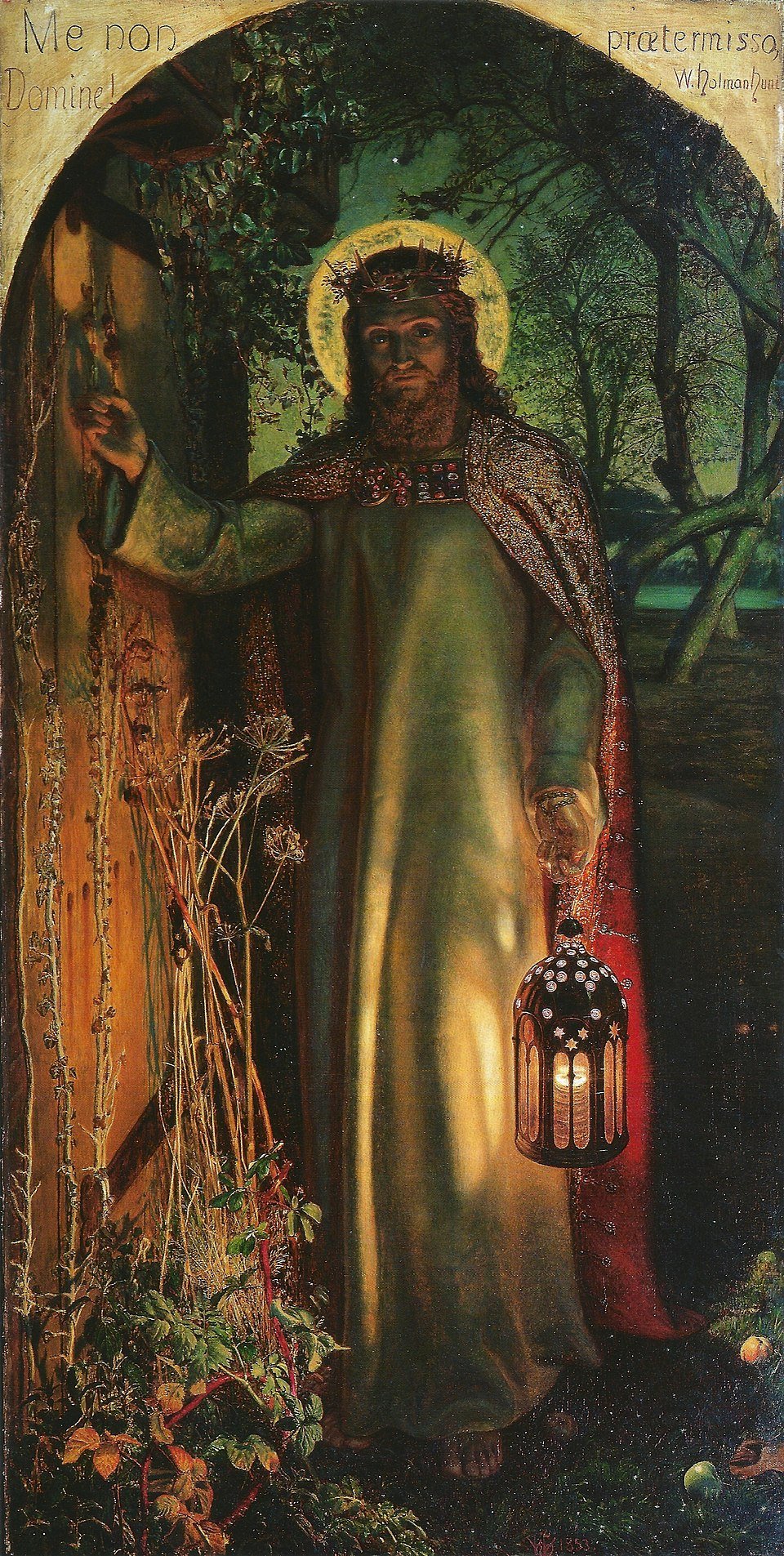
What struck me is the fact that meals are not simply something you do — like sleeping or walking. There’s a deeper, spiritual, significance to meals. Think of Revelation 3:20, a verse which Holman Hunt made famous in his painting The Light of the World:
Here I am! I stand at the door and knock. If anyone hears my voice and opens the door, I will come in and eat with that person, and they with me.
The thing which most most people remember about that verse is the standing at the door and knocking. But it goes on to say, for anyone who hears and opens the door, the Lord himself will come in and eat with them. The metaphor of eating together was chosen intentionally: the Lord coming to eat with us has profound spiritual significance. It means we share fellowship (or ‘communion’) with him… it means we know him.
And that’s the thing about meals: eating together is all about fellowship. You don’t tend to eat with people you don’t like — you definitely wouldn’t (willingly) invite them over to your house for a meal. If you invite someone round for a meal, it’s a gesture of love and friendship. This is why the early church held “love feasts” (Jude 12), which were most likely meals where the church got together to eat and celebrate the Lord’s Supper.4 Eating together and sharing the Lord’s Supper weren’t separated into two separate categories. Maybe this is why there is some ambiguity in the New Testament about the meaning of the words, ‘break bread’ (as in Acts 2:42) — whether it means ‘to eat together’ or ‘to share the Lord’s Supper’. Maybe we have introduced a distinction which the early church did not have.
The point here is that eating together is not something tangential to the point of the Lord’s Supper. The Supper reminds us that we, the church, are bound together through Christ’s body and blood. When we come together to celebrate, Christ is not absent but right there in our midst (Matthew 18:20). What happened to the two disciples on the Road to Emmaus is a good image — the two disciples meet Jesus, and recognise him when he breaks the bread at their meal. I don’t think this is meant to be the first Lord’s Supper, per se, but rather a picture of Christ coming among us and eating with us. Even though we don’t see him with our eyes, that doesn’t mean he is any less present.
In my opinion, one of the greatest mistakes of the modern church is to separate the Lord’s Supper from a meal. Most churches today don’t eat together very often, and when they do it’s usually a separate from taking bread and wine. The Lord’s Supper is celebrated as part of a ‘service’; meals are eaten at other times. Why this disconnect? The Lord’s Supper was originally within the context of a meal: the synoptic gospels make it clear that the bread and wine were taken during the course of the meal.5
I’ve mentioned fellowship several times already in this section, so let’s move on to think directly about that.
The importance of fellowship
This point is very much related to the previous one, but I think it’s worth making it explicit. The whole point of eating together is that we share fellowship. As I’ve said several times through this series, Christ did not come to make us a ‘team of individuals’. He came to form us into a new people, a new society. The church is not made up of private individuals, each with their own separate relationship with God but not to one another. We don’t come to church with our own private agendas that have nothing to do with one another. As God calls us into relationship with himself, he calls us into relationship with one another.
The Lord’s Supper is supposed to be not simply an expression of each believer’s individual relationship with the Lord, but rather a celebration that the risen Lord is in our midst. It should be a joyful expression of a Christ-centred community.
This is why Paul needed to write as he did in 1 Corinthians 11:17-34. The problem was that the Christians in Corinth were not eating the Lord’s Supper, even though they were taking bread and wine. He says:
So then, when you come together, it is not the Lord’s Supper you eat, for when you are eating, some of you go ahead with your own private suppers. As a result, one person remains hungry and another gets drunk. Don’t you have homes to eat and drink in? Or do you despise the church of God by humiliating those who have nothing? What shall I say to you? Shall I praise you? Certainly not in this matter!
1 Corinthians 11:20-22
The Christians in Corinth thought they were celebrating the Lord’s Supper, but they weren’t. The reason, Paul says, is because the way they went about it didn’t demonstrate love for one another. In fact, the way they were going about things actually caused humiliation for some of them. Paul’s overall point is that we can’t claim to be taking the Lord’s Supper if the way we are going about it does not demonstrate the fellowship we have with one another.
I think this is an extremely important point for us to take on board in our individualistic culture today. As I’ve said on numerous occasions throughout this series, many Christians today see church as being a vehicle for them to express their own private faith in God. Many, perhaps most, Christians don’t see church as about loving others. You can see this in many ways, including the way churches go about the Lord’s Supper: it’s not like sharing a meal in the ordinary sense. People take the bread and wine, quietly sitting on their own (or kneeling at the rail), thinking about their own sins and their own spiritual life, while barely giving a thought to anyone else.
Perhaps this is an exaggeration, but in my experience of church this is normal: people simply don’t connect their own sins with how they treat others in the church. They think of their own sin as occasionally doing the wrong thing, rather than thinking of sin primarily as falling short in our duty to love others — especially fellow Christians. ‘Fellowship’ for many Christians is a quick chat over coffee after the service before getting back to your own life. Obviously this affects everything about church, as I’ve been trying to highlight throughout this series. However, perhaps the greatest issue is with the Lord’s Supper, which is supposed to be an expression of our fellowship in and through Christ.
I wonder what Paul would have to say to the church today? Would he say to us today that we are eating the Lord’s Supper or not? This brings us to the final point.
The details are (relatively) insignificant
One of my biggest takeaways from this series is that God has given the church a large degree of freedom when it comes to how the church operates. We as Christians are supposed to love one another and help one another, and God has given the church pastors and teachers to help people understand the Bible and build their faith up in that way. When we meet together, we should be loving one another and helping one another. But within that, there are no hard and fast rules about how many times we should meet, where we should meet, what we should do when we meet, and so on. As long as we’re loving one another, the details don’t matter.
It’s the same when it comes to the Lord’s Supper. How often should we celebrate? Daily? Weekly? Monthly? Yearly? And what exactly should we do when we do take the bread and wine? These details are simply left for us to fill in.
Perhaps God did this intentionally because he wanted to teach us an important lesson. He wanted us to learn that fellowship with Christ and one another is more important than the specifics of how we share the Supper. As Paul said, if you take bread and wine but don’t truly share fellowship with others, “it’s not the Lord’s Supper that you eat”. It’s a bit like the Old Testament Israelites offering sacrifices at the temple without their hearts being in it. As Hosea put it:
For I desire mercy, not sacrifice,
and acknowledgment of God rather than burnt offerings.Hosea 6:6
If there is the presence of Christ through the Holy Spirit, and true love for one another, that matters far more than holding a weekly ceremony where bread and wine is distributed. What would God have to say to churches today who are strict about celebrating the Lord’s Supper every week, yet do not “love one another deeply, from the heart” (1 Peter 1:22)?
I do not say this because I think churches shouldn’t bother to celebrate the bread and wine. But rather, perhaps God has made the details somewhat sketchy because he doesn’t want us to miss the main point. We can’t take the Lord’s Supper if we do not recognise Christ’s presence with us every day. We can’t take the Lord’s Supper if we don’t seek to obey Christ every day. We can’t take the Lord’s Supper if we don’t embrace what Christ’s sacrifice means for how we live with one another.
Conclusion: Getting back to the reality
Something that I’ve been finding all the way through this series is that churches today have outward rites and ceremonies — such as the Lord’s Supper — but they are often lacking the inner reality.
If God is saying anything to the church right now, it’s this: stop focussing on the outward ceremonies and start focussing on the basics once again. Submit to Christ as Lord in every area of your life. Seek to obey him every day, in everything — put him first. Love one another, in the power of the Holy Spirit. If we focus on these things, perhaps the other problems with the church will right themselves.
Footnotes
- The names don’t have any particular theological significance apart from the Mass, which usually denotes the Roman Catholic understanding. Outside of the Catholic and Anglican traditions (e.g. Baptist churches), ‘Communion’ seems to be the most common. I believe the early church came to favour the term “The Lord’s Supper”, which Cranmer also used in the Book of Common Prayer, so this is the name I will use primarily. ↩︎
- I find it hard to understand the mindset of people who think that attending Midnight Communion was an obligation for them, but didn’t seem to think that coming to church the rest of the year was an obligation. To my mind this just goes to show that people will believe all sorts of strange things, which is why it’s important to ensure that people are taught properly. ↩︎
- The mischievous part of me wonders whether Matt Hancock would call that a ‘substantial meal’, but let’s leave that there for now… ↩︎
- I discovered that these were significant enough for Wikipedia to have a whole entry on them! ↩︎
- Mark 14:22 and Matthew 26:26 both say explicitly the Lord’s Supper occurred “while they were eating”. ↩︎
Leave a Reply