Creation, Evolution, and Evangelicalism
If you’re a long-time reader of this blog, you will know that I don’t shy away from the Big Questions: what I had for tea last night (pasta and chicken), what I think of the latest Coldplay album (at the time of writing Mylo Xyloto – I’m not a fan of it at the moment…), and the colour of the jumper I’m wearing (blue. No, gree – aaaaaaaahhhhh!!!! *ahem* apologies for the Monty Python reference).
However, I thought I’d break the mould this time by writing about creation and evolution: a subject I’ve talked about before on this blog several times. In fact, I have changed my mind since I started writing this blog – when I started this blog back in 2003 I was a 6-day creationist; however after reading a book called “Rebuilding the Matrix” by Denis Alexander I became convinced in the truth of evolution (unfortunately the link in that post to the Crossring forum post doesn’t work anymore as the forums have disappeared into the ether, but still).
In fact, so great an effect did “Rebuilding the Matrix” have on me that I mentioned it in fellowship group a couple of weeks ago – we each had to talk about a book that changed our lives, and I chose that one. And it was that meeting which has spurred me to thinking about creation again: I had previously thought that evolution was widely accepted in evangelical circles, but it seems that this isn’t always the case. I’m not sure how representative the group of people I was with actually were, but there seemed to be a number of questions to do with the theological significance of evolution: can we trust in the Bible still, if evolution is true?
Anyway, Denis Alexander has written another work more recently entitled “Creation or Evolution: Do we have to choose?“. I’m half way through reading it at the moment, but he has made some very interesting points already which I’d like to come to in my next post.
QI and Quirinius’ Census
I was watching QI XL last night, and the topic of the Bible came up (you can still see it on the iPlayer at the time of writing – at 20 minutes in). Now, it should be pointed out before we start that Stephen Fry has been known to be wrong before – he is not infallible! And on this particular occasion, I think he was wrong.
Stephen Fry and the panel made a few points about the census described in Luke 2:1-3.
The points were, broadly speaking:
- There was never a census of the entire Roman world;
- People didn’t have to return to their home towns in a census.
So the Lukan account of the census was put it only to account for the Bethlehem prophecy (i.e. Luke made up the gospel in order to account for all the prophecies). He (Stephen Fry) then went on to say “We’ve been cheated of books which should have been in the Bible”, and read an account from an infancy narrative of Jesus which happened to include dragons.
I have to say, I find this disappointing: QI prides itself on getting its facts right. It’s a shame that such a programme would broadcast what is essentially misinformation. On the two points above, there are plenty of sources (that last one looking particularly at the Greek text and the dating of the census, and – if you read on – coming up with what I believe to be an interesting resolution). In short, what QI said is simply not true.
This untruthfulness comes across again when they say it was basically a free-for-all when it came to which books were included in the Bible and which ones weren’t. Now this is such an incredible argument to make because it is totally false: It was used in the Da Vinci Code, for goodness’ sake, and we know how accurate that was! There is an article in my ESV Study Bible on the Canon of Scripture (it’s available online but you have to have an account) which gives an interesting overview of the history of the canon of what we call the Bible. Essentially, the early church didn’t decide what went in and what didn’t in terms of their own agenda, and it wasn’t decided many years after the fact.
The books of the NT were “self-selecting”, as it were; the books that were ‘chosen’ was simply a ratification of the books that already were in use by the majority of churches as authoritative.
Anyway, it’s disappointing to see ‘research’ like this make its way onto our screens, especially on a programme which is watched by millions of people. It’s just sloppy. QI, you have gone down a little in my estimation.
Autumn is the new summer
…given some of the temperatures we’ve had recently! That said, the last few days have been getting down to the kind of temperatures one would expect at this time of year. I’m not complaining, anyhow!
Just thought I’d make another post to update with my progress. We are nearly done with the first term here at Oak Hill, next week is the last week of lectures and then we have revision and exam week after that. Next Tuesday is the deadline day for assignments, so in the latter part of this week I think I’m going to be doing a fair amount of polishing and generally making my assignments ready for submission! I’ve got the word count for most of them, so it’s just a matter of actually checking they’re as good as I can make them.
Anyway, that’s how life at Oak Hill is going so far. I’m still enjoying it!
Apart from that we haven’t done much since half term – just the usual work and what have you. On Friday night there was a fireworks night at Oak Hill, Charli (who we know from Colchester) came along, and we all really enjoyed it. On Saturday we went to John and Liz’s for dinner (college friends), and had a nice time there. We ended up discussing “strategic” churches, and how the word strategic can be a pretty negative one in that context! Well, I suppose if you get a bunch of theological college students together you will end up talking about Christian things…
Right, I think that’s pretty much it for the time being. I’d better go and do some work. All for now.
Fireworks Night
Via Flickr:
We had a Fireworks night at Oak Hill last night. This was probably the only picture I took of the fireworks which is actually usable.
Autumn
phillsacre’s photostream on Flickr.
Went out for a walk this afternoon with Mrs Phil. We went alongside the Dollis Brook, something like the Dollis Valley walk but I’m not exactly sure. Anyway, it was a beautiful autumn day and I took some photos
Half Term
Just a quick update to say that it’s half term this week. After lunch on Friday, Phil and I drove back to Colchester, and that’s where we’ve been ever since. (Well, sort of.)
Phil’s sister Roz and her husband Matt joined us on Friday night – they were going to a wedding on Saturday nearby so they stayed a couple of nights with us. Our Saturday was pretty quiet though – in the morning we spent a bit of time shopping. One of the slightly odd things about living in London is that it’s actually harder to shop: in Colchester, we have pretty much everything we need in the town centre. In East Barnet, if you want to find (for example) a Debenhams, you have to travel a bit. Not that it’s really a problem, but still.
Anyway, in the afternoon we went for a walk around Highwoods, which was looking beautiful in the autumn sunshine, and then went round to see Anne-Marie and watch Merlin. Although it doesn’t feel like all that long since we were here last it was good to catch up!
On Sunday we went to Fordham in the morning, and spent some time after the service chatting to people who we hadn’t seen since August. Afterwards we went round to AJ and Jen’s with Roz and Matt for lunch (James, Tash and Jake came as well). Anyway it was a really good afternoon catching up and chatting! After that we went to Sunday@6, where I was roped into playing (not totally against my will!), it was quite strange actually – felt like normal really, even though it’s not really normal anymore!
So in general it’s been a nice weekend. Today Phil and I went over to Ipswich to see my parents and sister. Tomorrow I’m heading back to our London house (ha! That sounds so posh), and then I’m going to have three full days to get on with some work and hopefully finish my cultural exegesis essay. So now you know…
The Dawkins/Lane Craig non-debate
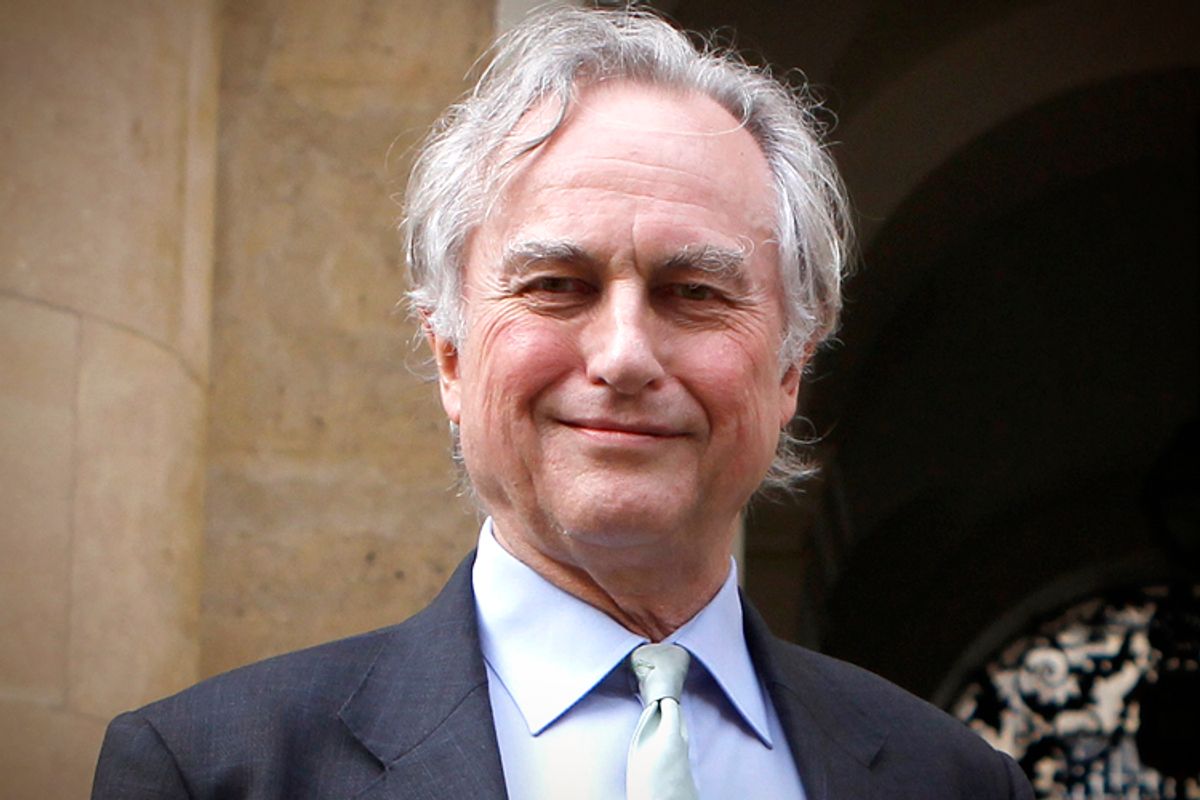
Richard Dawkins is stirring things up again. (Surely not! – sorry, I’d better not be sarcastic). In an article on The Guardian ‘Comment is Free’ section, he explains why he isn’t going to debate William Lane Craig. In case you don’t want to read the article, what Prof. Dawkins’ comments come down to is that William Lane Craig defends the God who commanded horrific genocide in the Old Testament. So, in the article, Dawkins quotes Deuteronomy 20 and says: “You might say that such a call to genocide could never have come from a good and loving God. Any decent bishop, priest, vicar or rabbi would agree.”
Now, I will leave aside Richard’s ‘arguments’ in the article itself (he doesn’t really make any, but still.) The whole thrust of the argument is basically: genocide is bad, I cannot debate with anyone who defends it. (I’d be interested to see what other people Dawkins has debated think about the Old Testament… William Lane Craig is by no means on his own with the view he holds).
However, in the quote I mentioned above, Dawkins does touch on one thing which I feel hasn’t really been explored, namely: “such a call to genocide could never have come from a good and loving God.” Now, this is an interesting one. How does Dawkins know that genocide is good or bad? Is he drawing on Biblical evidence? If so, what he has ‘proved’ is that the Bible is internally inconsistent.
However, I don’t think that’s what he’s saying. What he seems to think is that the God of the Bible is actually immoral. What I’d love to find out is, on what basis does Dawkins say that God is immoral? Or, to put it more specifically, on what basis does he say that genocide is immoral? Now, don’t get me wrong here, I’m not saying anything about the morality of genocide – I’m not questioning whether it’s OK! I’m just saying, how can Dawkins, as an atheist, claim that something is immoral? Or at least objectively immoral?
As William Lane Craig often says, 1. Without God, objective morals do not exist; 2. Objective morals do exist; 3. Therefore, God exists. What Dawkins seems to be doing in the article is making an appeal to objective morals. If he is, then I believe he is undermining his own position.
I’d love to hear him actually answer this issue properly, or at least be more precise in his language, but I fear that is simply a pipe dream.
Protesting Supermarkets
I’ve read a couple of articles recently which have got me thinking. The first one was about people who protest supermarkets such as Sainsbury’s, Tesco etc – unfortunately I can’t remember where I found it so I can’t link to it! (May have even been… hushed tones… on paper!) The other article was called Good News and Bad News, which I linked to on Twitter.
Anyway, it got me thinking about supermarkets and why people protest them. In many ways I actually support people who protest supermarkets: I do think that town centres can be ruined by large out-of-town stores moving in and taking everyone’s business away. But I have an issue with that, which is: whose fault is it that these stores are so big and so ubiquitous? It seems that blaming the stores for opening is ignoring the issue that there are people who shop there. The stores wouldn’t open if people didn’t shop there.
If the stores thrive because of unethical dealings with third world countries and slave labour etc – then that should be stopped. Of course it should. But that’s not really an issue people can solve by protesting against Tesco opening a new store in… whichever town they want to open a store in. It just seems to me that the rising flood of supermarkets is something which can only be ‘solved’ by proactively using local shops and businesses over the bigger chains and getting other people to do the same.
Aside from this is the issue that high-street shopping is gradually evolving – if it’s not actually dying out. Who buys CDs or DVDs or books from an actual shop these days? It’s just cheaper and more convenient to buy online. But you don’t find people protesting Amazon in the same way, do you? And I think in the past few years, online shopping has done far more damage to the high street than big supermarkets have.